Arrow Icon

Case Management

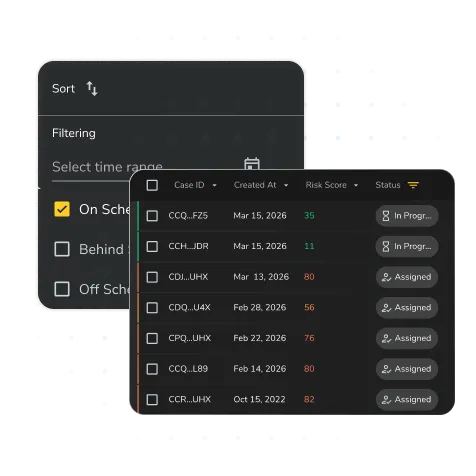
Accelerate investigations by unifying trade surveillance, transaction monitoring, and KYC alerts in a single case management console with shared risk intelligence and automated workflows.
Get a Demo

Advanced Capabilities

Multidimensional Case Prioritization

Synthesize risk signals across trade surveillance, transaction monitoring, and KYC intelligence to generate a unified alert layer. Correlate alerts through shared identifiers, behavioral signals, and contextual metadata while applying machine-learning scoring to dynamically prioritize investigations based on the severity and frequency of detected signals.

Unified Alert–Case Correlation

Correlate alerts, trading activity, and case history into a single investigation workspace designed for market abuse and financial crime reviews. Analyze related signals at the alert, case, and client level, contextualize market patters and transaction flows, and document findings through integrated audit logs, investigator notes, and structured escalation workflows.

AI-Powered Investigation Automation

Accelerate investigations through AI-driven automation that triages related alerts into coherent cases and enables investigators to execute bulk actions across large alert volumes. Surface contextual intelligence and streamline case handling to reduce manual triage while maintaining a complete and defensible audit trail.

One Surveillance Platform
For All Assets

Coverage across every market you clear and broker—cash equities, listed options, U.S. Treasury RFQ and IDB prints, cleared futures and swaps, FX, and crypto spot and derivatives
.

Visibility Into Market’s Blind Spots

Fully operational in opaque venues such as OTC markets and DEXs—detecting abusive patterns even in thin or fragmented books, with context-rich alerts that distinguish manipulative activity from natural volatility.

Cross-Product & Cross-Venue Abuse Detection

Uncover correlated manipulation across spot, derivatives, onchain and offchain markets —like cross-product spoofing and layering—that legacy surveillance systems miss by monitoring venues in silos.

Real-Time Detection of Market Abuse & Signal Distortions

Real-time detection fuses order book and behavioral analytics with external signals to flag spoofing, layering/quote stuffing, and socially amplified coordination—before it undermines best-execution evidence.
READY TO SEE HALO IN ACTION?
Schedule a call with a Solidus expert

Powered by Solidus HALO

One platform. Total control.

The compliance control center for modern financial markets - unifying trade surveillance, transaction monitoring, KYC intelligence, case management, and agentic workflows through a multidimensional, risk-based detection platform.
Learn More
Solidus' risk-based approach keeps us at the forefront of compliance and aligns with standards institutions recognize and trust
Integrating Solidus’ technology strengthens our ability to proactively detect and mitigate market abuse
Solidus Labs' on- and off-chain detection algorithms, coupled with a holistic compliance platform, align perfectly with our vision.
Request a personalized demo

See HALO in action

87% of Chief Compliance Officers
want smarter compliance solutions.

Discover how Solidus can help you prioritize alerts faster, optimize workflows, and ensure comprehensive coverage across assets and markets.

Say hello to HALO

FAQ

What is case management in digital asset compliance?

Case management in digital asset compliance refers to the process of aggregating alerts from trade surveillance, AML monitoring, KYC systems, and blockchain analytics tools into structured investigations that compliance teams can review and resolve. Solidus Case Management consolidates these signals into a unified investigation environment - a single pane of glass where investigators can analyze risk signals with full context, document findings, escalate cases, and maintain a complete audit trail for regulatory oversight.

Is investigating digital asset activity different from investigating traditional financial markets?

The principles of compliance investigations remain consistent across asset classes - detect suspicious activity, investigate risk signals, and maintain a defensible supervisory record. However, digital asset markets introduce additional complexity, including fragmented venues, onchain transaction flows, and pseudonymous counterparties. Solidus Case Management enables investigators to analyze cross on- and off-chain data, creating a unified investigation workflow across any asset class.

How are alerts grouped into cases in compliance systems?

Alerts generated across monitoring systems are often related to the same entity, transaction pattern, or trading behavior. Solidus Case Management correlates alerts using shared identifiers, client context, and risk metadata to automatically group related alerts into structured cases, including alerts originating from trade surveillance, transaction monitoring, and KYC controls.

How do compliance teams investigate alerts across multiple monitoring systems?

Investigators must review signals from multiple sources, including trade surveillance alerts, transaction monitoring alerts, client risk indicators, and blockchain analytics alerts. Solidus Case Management aggregates these alerts—including signals from KYT providers—into a single investigation workspace, allowing investigators to analyze trading activity, transaction flows, wallet intelligence, and client context without switching between systems.

What does a compliance investigation workflow look like?

Compliance investigations typically begin with alerts generated by surveillance, AML monitoring, or blockchain analytics systems. Investigators review related alerts, analyze trading activity and transaction flows, and document findings within structured cases. Solidus Case Management supports this workflow by aggregating alerts across trade surveillance, transaction monitoring, and KYC intelligence, enabling investigators to analyze risk signals and maintain a defensible supervisory record.

How do compliance teams manage large volumes of alerts?

Modern compliance programs generate thousands of alerts across surveillance and AML monitoring. Solidus Case Management reduces alert fatigue by aggregating alerts, correlating related signals into structured cases, and applying AI-driven prioritization. By surfacing the most material risks first, investigators can focus on meaningful investigations while even lean compliance teams can maintain oversight across high volumes of activity.

What evidence must firms maintain for regulatory investigations?

Regulators expect firms to maintain documented evidence showing how alerts were reviewed, investigated, and resolved. This typically includes investigation notes, supporting data, escalation decisions, and audit logs. Solidus Case Management maintains a complete investigation log, ensuring a defensible supervisory record during regulatory examinations.

How do compliance supervisors oversee investigations?

Compliance supervisors must ensure investigations are conducted consistently and escalated when appropriate. Solidus Case Management provides structured escalation workflows, audit logs, and exportable case reports across alerts generated by surveillance systems, transaction monitoring platforms, and KYT providers, enabling compliance leaders to review investigation outcomes and maintain documented supervisory oversight.
Solidus Labs Logo
Loader Animation