Arrow Icon

Execution Quality

Demonstrate Best Execution principles in digital asset markets through cross-venue benchmarking, contextual liquidity analysis, and defensible execution oversight
Get a Demo

Advanced Capabilities

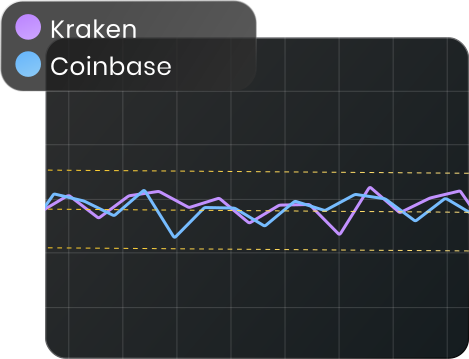
Multi-Venue Price Benchmarking

Evaluate execution prices against reconstructed reference midpoints across selected crypto exchanges to establish contextual execution benchmarks in markets without a consolidated tape or regulatory NBBO.

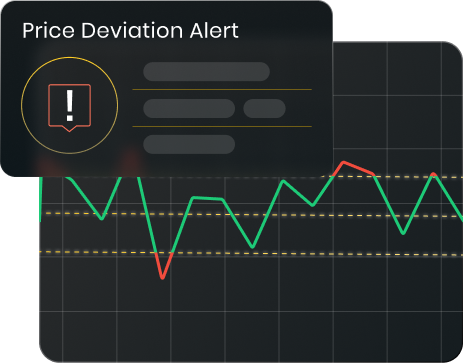
Execution Quality Deviation Monitoring

Continuously compare executed trades against reconstructed cross-venue benchmarks to identify abnormal price deviations and slippage that exceed configurable policy thresholds, dynamically calibrated for token liquidity tiers, trade size, volatility regime, and client segmentation.

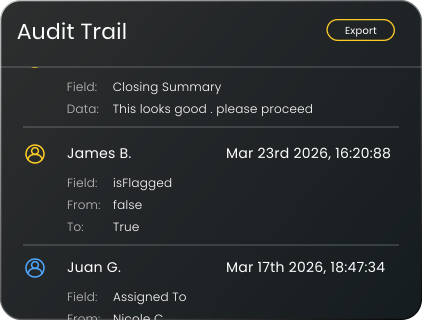
Defensible Execution Audit Trail

Maintain documented evidence that fiduciary obligations were evaluated and satisfied in digital asset markets through a defensible audit trail with easy-to-use reporting, including exportable alerts and execution data (CSV/Excel) designed to support internal committees, board-level review, and regulatory inquiries.

One Surveillance Platform
For All Assets

Coverage across every market you clear and broker—cash equities, listed options, U.S. Treasury RFQ and IDB prints, cleared futures and swaps, FX, and crypto spot and derivatives
.

Visibility Into Market’s Blind Spots

Fully operational in opaque venues such as OTC markets and DEXs—detecting abusive patterns even in thin or fragmented books, with context-rich alerts that distinguish manipulative activity from natural volatility.

Cross-Product & Cross-Venue Abuse Detection

Uncover correlated manipulation across spot, derivatives, onchain and offchain markets —like cross-product spoofing and layering—that legacy surveillance systems miss by monitoring venues in silos.

Real-Time Detection of Market Abuse & Signal Distortions

Real-time detection fuses order book and behavioral analytics with external signals to flag spoofing, layering/quote stuffing, and socially amplified coordination—before it undermines best-execution evidence.
READY TO SEE HALO IN ACTION?
Schedule a call with a Solidus expert

Powered by Solidus HALO

One platform. Total control.

The compliance control center for modern financial markets - unifying trade surveillance, transaction monitoring, KYC intelligence, case management, and agentic workflows through a multidimensional, risk-based detection platform.
Learn More
Solidus' risk-based approach keeps us at the forefront of compliance and aligns with standards institutions recognize and trust
Integrating Solidus’ technology strengthens our ability to proactively detect and mitigate market abuse
Solidus Labs' on- and off-chain detection algorithms, coupled with a holistic compliance platform, align perfectly with our vision.
Request a personalized demo

See HALO in action

87% of Chief Compliance Officers
want smarter compliance solutions.

Discover how Solidus can help you prioritize alerts faster, optimize workflows, and ensure comprehensive coverage across assets and markets.

Say hello to HALO

FAQ

What is execution quality in digital asset markets?

Execution quality in digital asset markets refers to evaluating whether trade outcomes were fair and aligned with client interests based on the market conditions available at the time of execution. Because digital asset markets lack a consolidated tape or NBBO benchmark, execution quality must be assessed through cross-venue benchmarking, liquidity analysis, and contextual evaluation of execution outcomes.

Solidus Labs addresses this challenge through its Execution Quality framework, enabling firms to evaluate execution outcomes using normalized market data and configurable execution benchmarks.

Why can’t traditional Best Execution frameworks be applied directly to crypto markets?

Traditional Best Execution frameworks rely on centralized infrastructure such as consolidated price feeds, protected quotations, and standardized market data. Digital asset markets operate differently: liquidity is fragmented across venues, assets trade across multiple quote pairs, and decentralized venues often use automated market maker (AMM) pricing models. As a result, execution fairness must be demonstrated through contextual analysis rather than a single benchmark price.

Solidus Labs developed its Execution Quality framework to address these structural differences by reconstructing cross-venue market conditions.


How can firms benchmark execution quality without an NBBO?

In markets without a consolidated tape or NBBO, firms can benchmark execution outcomes by reconstructing reference prices across multiple trading venues. This involves aggregating order book and trade data from several exchanges to create contextual execution benchmarks that reflect the liquidity realistically accessible at the time of trade. Solidus Execution Quality performs this reconstruction automatically, allowing firms to evaluate execution outcomes relative to real market conditions.

What is cross-venue price deviation monitoring?

Cross-venue price deviation monitoring compares executed trades against reconstructed benchmarks across multiple trading venues to identify abnormal price deviations or slippage. By analyzing contemporaneous prices and liquidity across exchanges, firms can determine whether an execution outcome falls outside expected market conditions. Solidus Labs’ Execution Quality framework uses cross-venue benchmarking models to automatically detect and flag these deviations for supervisory review.

How do institutions review execution quality in digital asset trading?

Institutional execution oversight is typically performed by trading or Best Execution committees that analyze trading outcomes across large populations of trades. Instead of evaluating a single trade in isolation, committees review patterns in venue performance, liquidity access, and execution outcomes over time. Solidus HALO supports these oversight processes by providing structured analytics, benchmarking tools, and reporting through the Solidus Execution Quality framework.

Which regulations require execution oversight for digital assets?

Several regulatory frameworks require firms to demonstrate fair order execution in digital asset markets. In the European Union, MiCA requires crypto-asset service providers to act honestly, fairly, and in the best interests of clients when executing orders. Similar expectations appear in supervisory guidance from regulators such as the Monetary Authority of Singapore and the Hong Kong Securities and Futures Commission. Solidus Execution Quality helps firms document and demonstrate compliance with these emerging execution oversight expectations.

What evidence do firms need to demonstrate fair execution in crypto markets?

To demonstrate fair execution, firms must maintain documented evidence showing that trade outcomes were evaluated against reasonable market benchmarks and internal execution policies. This typically includes cross-venue price comparisons, slippage analysis, and an auditable record of market conditions at the time of execution. Solidus HALO provides this evidence through the Solidus Execution Quality framework, offering exportable alerts, execution data, and structured reporting to support internal committees, auditors, and regulatory inquiries.

How do institutions review execution quality in digital asset trading?

Institutional execution oversight is typically performed by trading or Best Execution committees that analyze trading outcomes across large populations of trades. Instead of evaluating a single trade in isolation, committees review patterns in venue performance, liquidity access, and execution outcomes over time. Solidus HALO supports these oversight processes by providing structured analytics, benchmarking tools, and reporting through the Solidus Execution Quality framework.

How does Solidus HALO reconstruct execution benchmarks?

Solidus HALO aggregates order book and trade data from major digital asset trading venues and normalizes the information into a unified data schema. Using this normalized market data, the Solidus Execution Quality framework reconstructs contextual benchmarks such as cross-venue midpoints or liquidity-weighted prices. These benchmarks allow firms to evaluate execution outcomes relative to the market conditions that existed at the time of trade.

One Surveillance Platform
For All Assets

Coverage across every market you clear and broker—cash equities, listed options, U.S. Treasury RFQ and IDB prints, cleared futures and swaps, FX, and crypto spot and derivatives
.

Visibility Into Market’s Blind Spots

Fully operational in opaque venues such as OTC markets and DEXs—detecting abusive patterns even in thin or fragmented books, with context-rich alerts that distinguish manipulative activity from natural volatility.

Cross-Product & Cross-Venue Abuse Detection

Uncover correlated manipulation across spot, derivatives, onchain and offchain markets —like cross-product spoofing and layering—that legacy surveillance systems miss by monitoring venues in silos.

Real-Time Detection of Market Abuse & Signal Distortions

Real-time detection fuses order book and behavioral analytics with external signals to flag spoofing, layering/quote stuffing, and socially amplified coordination—before it undermines best-execution evidence.
Solidus Labs Logo
Loader Animation