





Who is Sugandhi Govil and what does Circle do? (00:00)
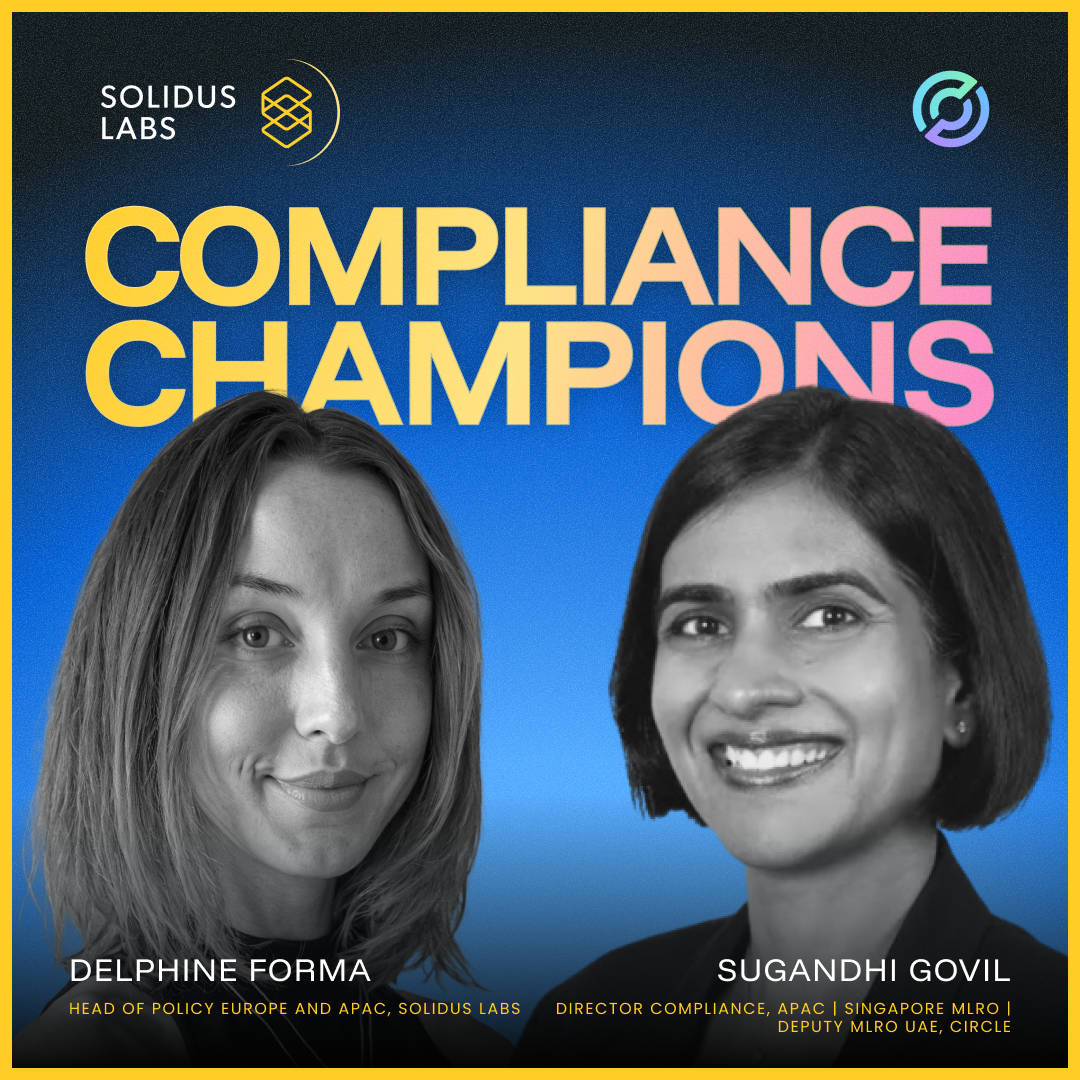
[00:00] Delphine Forma: Welcome to the Compliance Champions series. I'm Delphine, Head of Policy Europe at Solidus Labs and the founder of the Crypto Compliance and Legal Telegram Group, and I will be your host for today's session. I have the pleasure to be joined by Sugandhi Govil, Director of Compliance APAC, Singapore Money Laundering Reporting Officer and Deputy Money Laundering Reporting Officer, UAE, at Circle. I'm so happy to have you today.
[00:32] Sugandhi Govil: Thank you so much, Delphine. I'm super excited to be here as well. Thank you for having me.
[00:38] Delphine Forma: Maybe you can introduce yourself and share a little bit more about what you're doing at Circle.
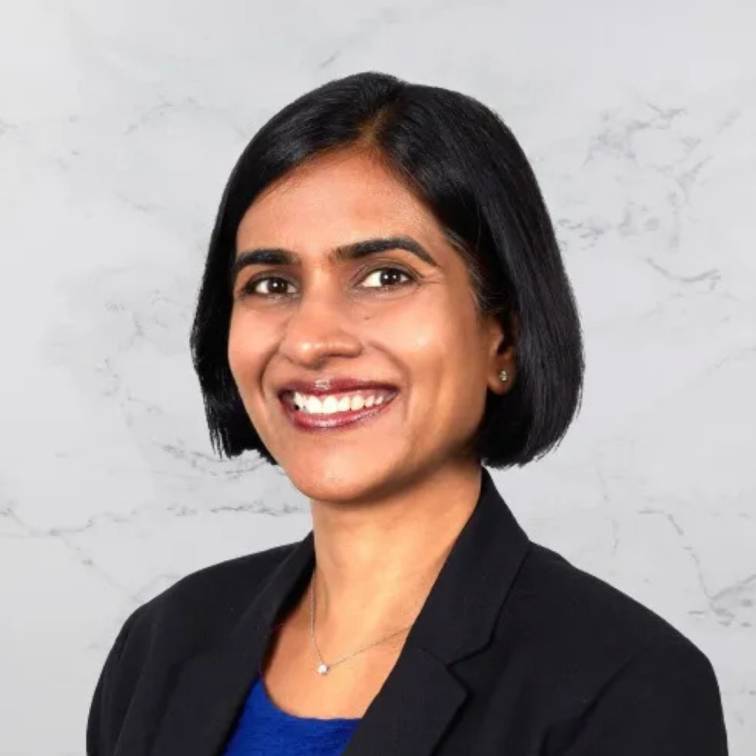
[00:43] Sugandhi Govil: Of course. As you said, I am currently leading the risk and compliance function for Circle in Singapore and across APAC. I am the MLRO for the Singapore licensed entity and also support the UAE license as Deputy MLRO there. Prior to joining Circle, I spent 20-plus years building and governing AML/CFT and regulatory compliance frameworks across both banking and digital asset institutions. I first entered the digital asset space in 2021, at a crypto OTC desk. Interestingly, it was just before one of the industry's most turbulent periods, if you remember, and I was questioning whether it was really the right move. But it was a great and very steep learning curve for me to really understand risk management in this space.
I joined Circle in 2023 as Director of Compliance for APAC. Circle, as most people would know, is a financial infrastructure company and the issuer of the two most regulated stablecoins, USDC and EURC. We hold licenses across multiple regulatory regimes, including MAS in Singapore, MiCA in the EU, the FSRA in the UAE, and several federal and state-level licenses in the US. My role here is to ensure that Circle continues to grow in the region while we safeguard the trust of the regulators, institutions and customers in the markets where we operate.
[02:25] Delphine Forma: Wow, this is really interesting. And indeed, 2021, working for an OTC broker just before FTX happened, must have been quite an interesting time from a compliance point of view.
[02:40] Sugandhi Govil: Absolutely, it was really interesting.
[02:44] Delphine Forma: We're going to talk about it a bit later, but it's a big switch, right, between OTC and a stablecoin issuer, as the compliance risks are completely different. Not completely different, but different, right?
[03:01] Sugandhi Govil: Absolutely. They're two different things. They're sometimes confused, like you rightly said, but they are very different.
What makes compliance for a stablecoin issuer different? (03:09)
[03:09] Delphine Forma: People tend to put everything in the same basket when they talk about the crypto industry, but there are a lot of different business lines and different risks associated with different businesses. So to start, let's look at why stablecoins are different. Stablecoins are often grouped together with the broader crypto industry, as I just mentioned, but from a compliance and risk perspective, they are different. What makes compliance for a stablecoin issuer so unique?
[03:47] Sugandhi Govil: In terms of the financial crime risks, they are typically the same, and all of us are very familiar with them. We are still dealing with money laundering, sanctions evasion, fraud and terrorist financing. What is different is the environment these risks operate in, and that requires a different approach to compliance. Two things make it specifically unique for a stablecoin issuer. Firstly, a regulated stablecoin is literally a digital representation of fiat money, which is very different from other crypto assets you would see in the market, which are more speculative in nature. That means trust has to be implicit in this technology. Just like you trust fiat money, you should be able to trust a digital dollar moving on the blockchain.
In traditional finance, this trust is largely inherited. Licensed banks, which have been there for ages, benefit from decades of institutional history, an established regulatory framework, strong regulatory relationships and so on. But a stablecoin issuer has to start from a different place. We do not have that luxury. Every regulator we work with, the institutions that come to us and the customers we have all have to gain confidence that every token we issue is backed as promised, can be redeemed when they need it, and is supported by strong governance and effective controls. That's where execution becomes very important. For a stablecoin issuer, trust really has to be earned continuously, transparently and without any exceptions. So the frameworks, the governance and their execution become very important.
That really shapes the way we approach compliance as a stablecoin issuer. The second piece is the technology. Blockchain technology gives us visibility beyond our own customer base, which is unlike anything we have seen in traditional finance. It gives us a strong advantage, because we can continue to observe how the stablecoin moves after it enters circulation. That was not the case with fiat money: once it left the walls of the institution issuing or distributing it, you wouldn't know where it was going. This also shapes the way we think about compliance, because it gives us insight into risks beyond our direct customers and allows us to identify emerging typologies much faster, in ways that have never been possible in traditional finance.
So these two things really shape how we fundamentally think about compliance as a stablecoin issuer.
How do stablecoin issuers manage risk once tokens are in circulation? (06:33)
[06:33] Delphine Forma: Indeed, and you made really interesting points. The first one on trust: customers need to trust you, and you need to gain that trust as a new player. And the fact that blockchain technology is fully transparent gives you insight you would not have in traditional finance. I could not emphasize that more. Even though the technology has been around for so long, people still misunderstand this part. Thanks to the technology, you can actually see what is happening when the token leaves your ecosystem. A stablecoin issuer generally only directly controls issuance and redemption.
Once the token enters circulation, it will move across exchanges, wallets, DeFi protocols and different jurisdictions globally. How does that shape the way you think about compliance and risk management?
[07:42] Sugandhi Govil: That's a very interesting question, because this circulation, and the visibility that blockchain gives us, as we just discussed, shapes a lot of how we think about compliance and risk management. I would take it one step further and compare it to a central bank and fiat currency. A central bank issues the currency, but it doesn't monitor every movement of every banknote once it is in circulation. Stablecoins operate in much the same way. The interesting part is that, because we have blockchain technology, we have new tools to see those risks and manage them.
We take that into account when we think about compliance, and it gives us great power to shape the compliance program in a way that can address emerging risks. The first principle is that our strongest controls obviously sit where we have direct accountability: our onboarded customers, where we can conduct due diligence, screen for sanctions and monitor customer activity. This is where we have the relationship, the context of the customer's business and transactions, and the authority to act. These points remain the foundation of our compliance program. The second is the visibility we have been speaking about. This broader visibility across the ecosystem gives us emerging risk signals, such as exposure to sanctioned addresses or movement through high-risk venues.
We can understand where our stablecoin is really moving and what transaction patterns might warrant closer attention. Because these transactions happen in near real time on the blockchain, our risk management also has to operate in near real time, and that speed really shapes how we think about our compliance program. Even though the activity is visible, what matters is the capability we have to identify, assess and respond to emerging risks before they become more significant. The third piece is that we all, as an ecosystem, have to recognize that no single participant can manage this risk alone. We need a whole-of-ecosystem approach.
Once a stablecoin enters circulation, every participant sees a different part of the picture. Issuers can issue and redeem, and they can observe movement across the network. But exchanges and custodians hold the customer relationship and the context once the token moves out of the issuer's direct ecosystem. Then we have blockchain analytics providers and law enforcement, each with their own intelligence and capabilities, who can build the whole picture together. Effective risk management depends on these perspectives coming together, with strong public-private partnerships operating at speed, where responsible information sharing is critical. As we know from traditional finance, financial crime doesn't respect organizational or jurisdictional boundaries.
So the strongest outcomes will come from acting as an ecosystem and managing the risk together.
Where does a stablecoin issuer's responsibility end in the secondary market? (11:23)
[11:23] Delphine Forma: That's a very good point, because you need to find the balance. When you have the direct relationship, you are obviously fully responsible. And this technology brings new ways of working. I think the central bank example is very powerful: they issue but then cannot see, whereas you issue and you can see. It makes me jump to another question: how do you actually determine your responsibility as an issuer? Where does it begin and where does it end when it comes to activity in the secondary market? We agree that for direct exposure, if it's your customers, it's on you.
But as you mentioned, you rely on partners, and everyone has their own responsibility. How do you balance all that?
[12:18] Sugandhi Govil: For me, responsibility has to go together with the authority to act. Secondary market monitoring is really about building situational awareness and risk intelligence beyond our direct customer relationships. But responsibility has to sit where the customer relationship, the contextual information and the legal authority to act come together. As stablecoin issuers, we use secondary market monitoring to understand how our stablecoin is moving through the broader ecosystem and where new risks may be emerging. In practice, we use it in several ways: to monitor the activities of our key ecosystem participants and strategic counterparties, identify any exposure to sanctioned or high-risk wallets, and detect emerging financial crime typologies.
It gives us valuable insight into the health of the ecosystem beyond the point of issuance, which we then feed back into our compliance program. It helps us prioritize investigations, calibrate our controls and inform customer risk assessments. So secondary market monitoring, for us, is about turning blockchain transparency into actionable risk intelligence, while recognizing that actual responsibility lies where the customer context and the authority to act are available. Those have to come together to act on what we are seeing, and that's where partnership becomes very important.
When can a stablecoin issuer freeze or burn tokens? (14:02)
[14:02] Delphine Forma: Really interesting. I agree that responsibility starts where you can legally act. But that makes me think of something that might be a slightly more controversial question. When we talk about the ability to act: because you issue the stablecoin, you have the ability to freeze and block, if I'm not mistaken. So you technically have the ability to act at any point. I'm really curious to know how those functions work in practice. When are they used, and how do you balance those controls against expectations around neutrality and censorship resistance?
[14:50] Sugandhi Govil: That's definitely a controversial question, Delphine, and something that has been talked about a lot: now that the technology to freeze and block is at hand, what can issuers really do? At the technical level, as you rightly said, a regulated stablecoin issuer can design smart contracts to freeze tokens associated with a particular address or, in exceptional circumstances, burn those tokens completely and remove them from circulation. But what's important to understand is that the capability and the legal authority to act on it are two different things. The technology makes it possible for us to freeze or burn, but it doesn't determine when those powers can be used. That authority comes from our legal and regulatory frameworks, which sit completely outside the technology itself.
Whether it's a sanctions obligation, a court order or another lawful direction from a relevant authority, we need the right governance to ensure those legal obligations are translated into a clear, well-defined and auditable decision-making process. The key point for any stablecoin issuer is to make sure that these powers to burn or freeze are never exercised simply because they're technically available. Regulated stablecoins operate within a legal and regulatory framework, and there should be clear guidelines and responsibilities that come with issuing regulated financial infrastructure. If we were to intervene arbitrarily or inconsistently, that would undermine confidence in the technology, because those powers would then be exercised outside the legal and governance framework.
That's why governance really matters. Institutions and users who rely on us need to know when these capabilities will be exercised, what the legal basis is, and whether there is a transparent, well-governed process for the issuer to do so. It is not just the existence of a freeze-and-block capability that determines trust, but the discipline with which it is governed and the consistency with which it is applied. That's what is very important in the context of regulated stablecoin issuance.
How do you build a compliance program for a stablecoin issuer? (17:19)
[17:19] Delphine Forma: Wow, you gave a lot of really good insight, and I could not agree more. While you were talking, I was thinking that again, it's all about trust. When you build a governance framework, do you have any advice on how to build your compliance program and the governance around these very specific issues that we haven't seen in traditional finance before? Maybe take a step back: when you joined Circle three years ago, how did you go about building this new governance framework with these new issues?
[18:04] Sugandhi Govil: When I first came into the crypto world, as I mentioned, it was a very steep learning curve, and there has been a lot of learning from both the failures and the successes I have seen. For building a compliance program for a stablecoin issuer, there are three pillars I think of when designing a program. The first is compliance by design. When we are building financial infrastructure that operates at global scale and moves at the speed of the network, compliance can't be an afterthought. It has to be embedded into the product from the outset.
When we are thinking about the product, compliance teams or compliance heads have to have a seat at the table, so the product can be developed with the required controls operating in real time. Those design decisions will determine whether the product can scale safely and earn institutional trust. The second pillar is that financial crime controls need to operate at network speed. In traditional finance, we had business hours, batch processing and weekends when traditional banking did not operate. But stablecoin networks operate continuously, 24/7. So compliance controls have no choice but to operate in near real time as well. Another very important point is that financial crime typologies evolve just as quickly.
So the controls have to be agile. It's not as if we put a control in place today and can forget about it tomorrow. We have to continuously review its effectiveness and refine it, because criminals are evolving as quickly as the technology. In this environment, controls that work today may not be effective tomorrow. That is the second principle. The third, which I touched on earlier, is the principle of continuous assurance. By that I mean a compliance program that can withstand scrutiny at any point in time and is run through disciplined execution and strong governance. A regulated stablecoin issuer does not have the luxury of inherited confidence from institutions and regulators. As I said, we have to build it from the ground up.
That means building a program that demonstrates it operates as expected across all the necessary pillars. For instance, reserve management, independent attestations and robust financial crime controls all have to operate and execute as intended, so that we can build that trust with our partners and regulators. That is how I think about building a compliance program for a stablecoin issuer.
What financial crime red flags do stablecoin issuers monitor? (21:07)
[21:07] Delphine Forma: This is really fascinating. You mentioned a very important point: compliance needs a seat at the table. Yes to that. I think that applies to everyone working in the industry. It's so important to always remind founders that compliance is a business enabler, and if they want the project to succeed, they need to embed compliance controls from the beginning. You also mentioned continuous assurance and making sure your compliance program always works as planned. And something I'm really passionate about is financial crime controls and the fact that typologies evolve very fast. When it comes to financial crime typologies, what are the key red flags your team looks at, and what tools support you in detecting and preventing suspicious activity?
[22:09] Sugandhi Govil: Sure, happy to dive into that, Delphine. The red flags themselves are quite similar to what we see in traditional finance. What is different is the manner in which they emerge, due to the technology we are using, the amount of information available and the speed at which we need to identify emerging risks. Typically, we look for transaction patterns that don't make commercial sense, like rapid movement of funds, increasingly complex wallet structures, cross-chain activity designed to obscure the source or destination of funds, or activity that is inconsistent with what we know about our customer or a wallet. Another area we pay close attention to is counterparty risk, which we can assess through the tools we have today.
We can assess exposure to sanctioned addresses, high-risk VASPs, mixers or other illicit infrastructure. Public blockchain data gives us much richer insight into these connections, and today's analytics tools are super helpful for these kinds of investigations. When risk signals cross a threshold where we feel they are really suspicious, we do a deeper dive into the flows. Blockchain analytics platforms allow us to trace funds, identify wallet clusters and detect emerging typologies. This information is fed into our systems so we can detect and monitor how typologies are changing, given that crime is also moving at the speed of the technology itself.
From there, there's a structured compliance process: if we feel something is really suspicious, we investigate, escalate internally, and file a suspicious transaction report where needed, if it is beyond our risk appetite. The technology we have, including blockchain analytics and now AI, is really helping us enhance our workflows so that we can stay ahead of this on a real-time basis. That's the fundamental advantage the technology gives us.
[24:33] Delphine Forma: Wow. As a follow-up question, is there one type of financial crime you see emerging right now? I have an idea what you're going to say, but I'm curious.
[24:49] Sugandhi Govil: I would say the biggest risk we see is that financial crime is evolving at the same pace as the technology. The same technology we use to issue the stablecoin and allow digital money to move fast and at low cost also enables bad actors to move illicit funds faster and with increasing sophistication. The typologies we see increasingly are complex wallet structures and cross-chain activity, especially on chains that are not as well supported by blockchain analytics.
Those are the chains that become the place where most bad actors move funds on-chain. The challenge for us is staying ahead of the curve and ahead of these bad actors, so that we can prevent misuse of our stablecoins or illicit activity. Compliance really can't be static. In our case, we have to have processes in place to review constantly and feed back where we need to tweak our transaction monitoring rules and behavioral rules, or the blockchain analytics, internal tools and rules we use, to make sure they stay current and relevant for the activity we are seeing on-chain.
[26:29] Delphine Forma: That sounds very busy, because staying ahead of the curve and ahead of criminals is not an easy job. It's also something regulators really care about. It's interesting: with regulators, it feels like the more you can do, the more they want you to do. They really care about this, right?
[26:57] Sugandhi Govil: Yes. Financial crime is always at the top of every regulator's concerns, and it is the biggest risk we have to constantly work on. It also comes up most often in our conversations with regulators, and we need to make sure we give them enough comfort that they understand how we are managing the risk.
What are the compliance challenges of multi-issuance stablecoins across APAC? (27:22)
[27:22] Delphine Forma: Exactly. Another concern of regulators, not just recently but for some time now, is multi-issuance of stablecoins. Stablecoins are obviously meant to be used globally. They are digital and global, and they need to be able to circulate from country A to B to C, otherwise they lose their purpose. We're seeing a lot of discussion around the world, and when regulators look at it, they want their own local regime with very specific local requirements. What are the biggest compliance and operational challenges of a multi-issuance strategy across APAC?
[28:10] Sugandhi Govil: When we do multi-issuance of different stablecoins, each one is really a separate regulatory promise. Each stablecoin has to meet the regulatory expectations of the jurisdiction in which it is issued, and that's what makes the compliance challenge so complex. Each carries its own regulatory obligations, its own reserve arrangements, its own redemption commitments and its own supervisory expectations. You cannot assume that because you do one stablecoin well, you can also do the second well, because they are two entirely different regimes. You have to make sure the programs you build across both are effective enough to meet the requirements of the jurisdiction in which each token is issued.
Every new issuance has to earn regulatory and institutional confidence in its own right, and that is a very complex problem to solve. The second challenge is governance. Even if you have multiple compliance programs, you have to operate them as one organization. You are the issuer, so you cannot have entirely separate programs. There has to be coherence across the programs you develop, and that's where accountability, decision-making and risk management become harder. You have to balance local regulatory expectations while maintaining a global culture, risk appetite and standard of execution. That's the complexity of multi-issuance, and I think everyone across the industry is consistently trying to solve it.
[30:08] Delphine Forma: Indeed. And I think it's especially complex in APAC, because in Europe we have MiCA and in the US they have the GENIUS Act, but in APAC you have a multitude of countries, each with their own regulatory framework and their own culture. People tend to see APAC as one region, which is true, but there are so many variations between the different countries. How do you actually navigate that?
[30:41] Sugandhi Govil: That's a very fair point, and people living in APAC understand very well that APAC is not one APAC. It is a multitude of countries that need to be managed. This is also the region where most of the action is happening, so it's a very exciting region to watch and work in right now. The approach we mostly take is to ensure we have constructive engagement across all the regulatory markets where we see more activity. One thing we have experienced and really appreciated is that, across the jurisdictions in APAC, regulators are willing to spend time understanding how stablecoins actually work.
There's a very constructive dialogue that our policy, legal and compliance teams are continuously having with regulators in each jurisdiction. The positive part is that, as regulators try to understand the operating model and the practical compliance challenges, the depth of these conversations leads to regulations that are grounded in the realities of the business. That results in frameworks that may be more practical and durable. We see that across Singapore, Hong Kong, Japan and Korea, which all have very active regulators who want to understand how this technology works and are willing to have a two-way dialogue.
The second piece is that we see a lot of convergence around fundamentals, and that's really heartening for us in this region. These are different jurisdictions, and there may be some differences in the way regulations are developed, but we see a fundamental convergence around the core expectations: governance, reserve backing, transparency, and strong, consistent AML/CFT controls. This provides greater certainty for both the industry and regulators, and gives us assurance that we can work in these jurisdictions while supporting responsible innovation. That's a very positive development. All in all, APAC is a great place to be working right now, and working through all these regimes and challenges together with the regulators makes it super exciting.
[33:30] Delphine Forma: Indeed, as you mentioned, there are so many things happening in the region right now and so many new initiatives. I'm really looking forward to working more closely on those topics. Is there any regulatory approach in the region that you look to as a positive model, or new regulatory developments coming that will impact stablecoin issuers?
[33:59] Sugandhi Govil: As I mentioned, the beauty is the engagement we are having, and the approach we see from all the regulators in the region is that they are trying to understand how stablecoins work. Some regulators are very advanced, like Singapore, Hong Kong and Japan. They already understand how stablecoins work, what the advantages are and how they can be regulated, and they're super savvy about the technology, which is great. Other regulators are coming along on the journey and asking us the right questions: what is our operating model, what are we seeing in other markets like the US and the UK, and what is working and what is not?
That approach is very heartening to see in APAC. Secondly, I see a clear focus on regulatory outcomes rather than being overly prescriptive, because the more prescriptive regulations get, the harder it becomes for global issuers like us to meet all the local requirements. The intention should be to define the risk, define the expected outcome, give the industry the flexibility to achieve it, and maintain clear oversight of how the industry achieves those outcomes. That's coming through in the region as well, which is very heartening.
What do regulators misunderstand about stablecoins, and are banks competitors? (35:38)
[35:38] Delphine Forma: When we talk about regulators, what do you think is the biggest misconception regulators still have about stablecoin issuers?
[35:50] Sugandhi Govil: There's been a lot of progress, but one misconception I still sometimes see is that we are taken to be akin to the broader crypto ecosystem. As we said at the start of our conversation, a regulated stablecoin issuer is very different from any other crypto token out in the market, and therefore the financial infrastructure and compliance frameworks we develop are very different. We are a regulated financial infrastructure, which means our operating model, governance and compliance are much closer to those of a regulated financial institution than to those of a trading platform.
So while the financial crime risks seem familiar from other crypto, how we look at compliance is quite different from how a crypto issuer whose token is not backed one-to-one by fiat currency would be viewed. That is the biggest misconception. Regulators who have engaged closely with issuers are increasingly recognizing that difference, and that's shaping the more mature regulatory frameworks we see emerging around the world now.
[37:09] Delphine Forma: Indeed, and we see more dedicated regulatory frameworks for stablecoins, which I think is good to see. Knowledge is increasing slowly but surely.
[37:20] Sugandhi Govil: Absolutely.
[37:24] Delphine Forma: I still have a couple of questions, and another slightly controversial one. When we think about stablecoins, we see a lot of different entities around the world trying to issue them. For instance, banks and financial institutions are increasingly trying either to issue their own stablecoins or to use tokenized deposits. Do you see them as competitors, partners, or something in between?
[38:01] Sugandhi Govil: Interesting question again, Delphine. My answer would be something in between, and I actually see it as a very healthy sign for the evolution of digital money. It's important to recognize that banks and regulated stablecoin issuers are not trying to solve exactly the same problem, though it may seem that way. Banks are extending commercial bank money into digital infrastructure to serve their existing customers and payment ecosystems, whereas regulated stablecoins are building interoperable digital money infrastructure that can move across institutions, across borders and across public blockchain networks. So while there's some overlap, they are not identical.
That means there will be areas of competition where use cases converge, but there will also be places with completely different use cases and no real competition. These are not mutually exclusive choices; they're complementary parts of a broader financial system, and each will have its own place. What's important to see is the direction of travel. Digital money is evolving: we have regulated stablecoins, tokenized deposits, and potentially central bank digital currencies. All of these will coexist, each addressing its own use cases while being interoperable where appropriate. That's where we are eventually heading.
This is obviously a journey, and it seems a bit unclear at this moment. The most encouraging development is that every credible institution you can think of, whether a bank, a financial institution or a major corporate, is entering or trying to enter the space, which will raise the overall standard and shows clear adoption. That's where strong governance and clear regulation become competitive necessities rather than differentiators. People are no longer asking whether this is going to happen. It's about how we raise the bar for the entire industry together.
[40:20] Delphine Forma: Exactly. It will be really interesting to see what happens and what the financial system will look like in three years. I think it can move very fast. You also mentioned something absolutely key: interoperability. Without technological and regulatory interoperability, it would be quite difficult to achieve. But we're arriving at the end, and none of my guests can escape the last question: are you following any fashion trends?
[41:04] Sugandhi Govil: Okay, now this is a completely different one. For me, the fashion trend would be cool and comfortable. At my age, and in Singapore's weather, I really believe in wearing comfortable clothes. The material, the fabric and the colors should all be designed to give me comfort and make me feel confident while being comfortable. So for me, the trend is clothing that suits Singapore's environment and climate. And I'm starting to like more color in my wardrobe.
That's the change that has happened. It used to be all blacks and blues, but now I'm moving to a place where I would love to have more pastel and brighter colors, depending on the day, the time and the mood I'm in.
[42:10] Delphine Forma: I love it. It's so true: comfortable and cool clothes in weather like Singapore's are extremely important. And I'm with you on color; I think I'm following the same trend. I used to wear all black, and now my wardrobe has green, there's pink. I'm like, whoa.
[42:32] Sugandhi Govil: Yes. We need to bring more color, right?
[42:35] Delphine Forma: Exactly. And more color to the space too, right?
[42:38] Sugandhi Govil: Totally. This is an exciting space. It needs more color for sure.
[42:44] Delphine Forma: Sugandhi, thank you so much for your time today. I really enjoyed the conversation and your great insights. Thank you so much.
[42:52] Sugandhi Govil: Thank you so much, Delphine, for having me. It was lovely talking to you. My pleasure.


